
Modern applications are no longer just APIs and UIs. They increasingly involve AI models, tools, agents, and contextual data that must work together in a reliable and scalable way. This is where Model Context Protocol (MCP) comes in.
In this article, you’ll learn what MCP is, why it matters, and how .NET developers can get started building MCP Servers and Clients using the C# SDK.
What Is MCP?
Model Context Protocol (MCP) is an open protocol designed to standardize how applications provide tools, data, and capabilities to AI models and agents.
Think of MCP as a bridge layer between:
- AI clients (LLMs, agents, copilots)
- Backend systems (APIs, databases, services)
- Tooling and workflows
Instead of tightly coupling AI logic with backend APIs, Database, files, or any backend system, MCP provides a structured, discoverable, and secure way for models to interact with external systems.
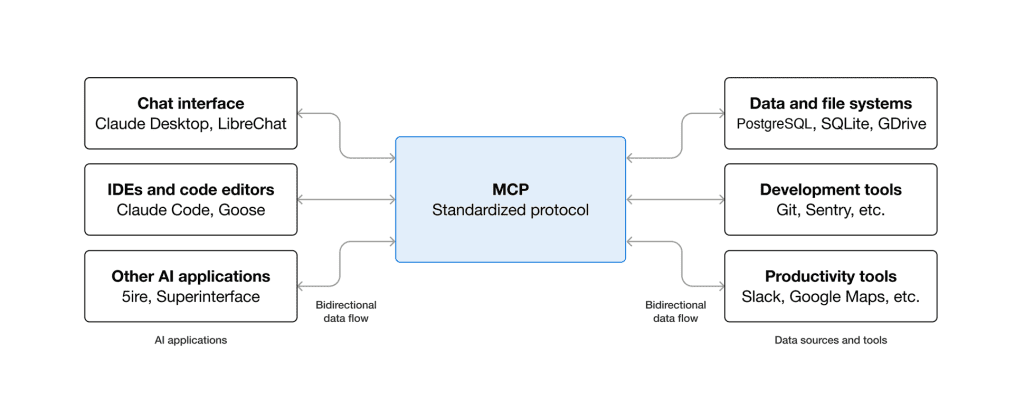
Simply, we can say Model Context Protocol (MCP) is a standardized way to expose your application’s capabilities, such as APIs, services, or workflows, to AI models and agents.
For instance, instead of hard-coding API calls into AI prompts, MCP lets you:
- Expose tools in a discoverable way
- Pass structured inputs and outputs
- Keep business logic clean and reusable
- Scale safely into production
Think of MCP as an AI-ready abstraction layer over your existing backend. In simple Analogies, MCP acts as a universal connector or a universal standard protocol to connect: LLMs, APIs, Tools, Local applications, and, Cloud services.
Why Do We Need MCP?
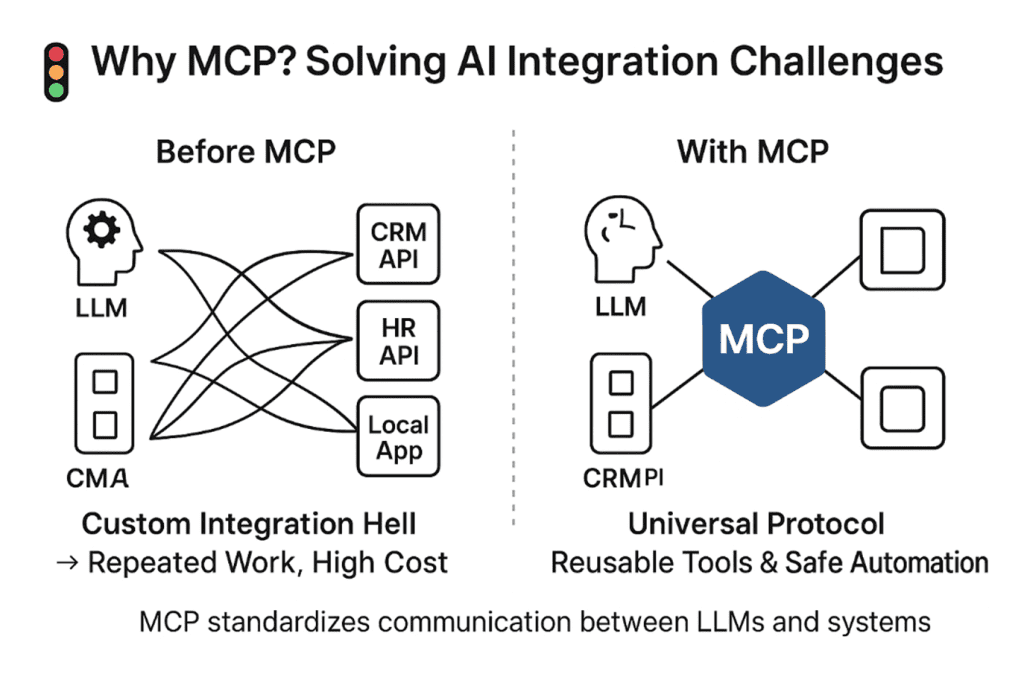
Today, AI systems, whether LLMs, apps, browsers, VS Code extensions, or backend APIs, don’t speak the same language. Every tool has its own custom API, its own auth, its own integration model. That means anytime we want to connect AI to a system, we write custom code. Over time, this becomes very expensive, fragile, and insecure.
MCP, or Model Context Protocol, solves this by introducing a universal standard. Think of MCP as the ‘USB port’ for the AI one protocol that any LLM, any tool, and any application can understand. Instead of custom integrations for every system, we create MCP tools once and reuse them across different AI clients.
This matters because we are entering an Agent-driven era, where AI doesn’t just answer questions—it performs actions, retrieves enterprise data, and automates workflows. MCP provides structured, contextual, safe communication between AI and applications so they can actually work together reliably.
The key idea:
Before MCP: integrations were custom and isolated.
After MCP: integrations become standardized and reusable.
That sets the stage for why MCP is so important, especially for enterprise developers and architects in 2025.
Let’s take a scenario, traditional REST or gRPC APIs work well for application-to-application communication, but AI-driven systems introduce new challenges:
- Models need context, not just endpoints
- Tools must be discoverable at runtime
- Responses must be machine-interpretable
- Security and permissions must be enforced consistently
- Agents need to orchestrate multiple tools dynamically
MCP solves these problems by:
- Defining a standard protocol for tool exposure
- Enabling dynamic capability discovery
- Supporting agent-based and AI-first architectures
- Decoupling AI clients from backend implementation details
MCP for .NET Developers
If you’re a .NET developer, the good news is:
- MCP fits naturally into ASP.NET Core
- The C# MCP SDK feels familiar
- Existing services can be reused
You don’t need to redesign your system; you can wrap your existing logic with MCP.
When Should You Use MCP?
MCP is ideal when:
- You’re building AI agents or copilots
- You want tool-based AI interaction
- You need dynamic capability discovery
- You want to decouple AI from backend services
Conclusion
Model Context Protocol is a powerful foundation for the next generation of AI-powered applications. For developers, it provides a clean, structured, and scalable way to expose backend capabilities to AI systems. Embracing MCP today sets your applications up for the next wave of development, where agents, models, and intelligent workflows work together seamlessly.
References:
•https://modelcontextprotocol.io/docs/getting-started/intro